
HAL, BEL and MDL feature on Sipri's list of the 100 largest arms producers in the world.

India remained the world's top arms importer, but its imports declined by 11 per cent between 2013-17 and 2018-22, according to a report released on Monday by Stockholm-based defence think-tank SIPRI.
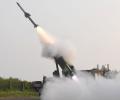
'China is in the middle of a substantial expansion of its nuclear weapon arsenal, which satellite images indicate includes the construction of over 300 new missile silos,' SIPRI's statement noted.

With military expenditure of USD 81.4 billion (one billion=100 crore), India's spending was up by six per cent from 2021 and by 47 per cent as compared 2013.
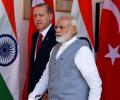
India-Turkiye ties are strained over Ankara's Islamabad tilt, its arms links with Pakistan, and fallout from the Pahalgam terror attack.
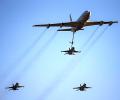
While the US continues to shell out the largest defence budget in the world year after year, other nations are slowly but certainly catching up, says the Stockholm International Peace Research Institute.

The increase in India's military spending was "mainly a result of growing personnel and operations costs" which made up almost 80 percent of the total military budget in 2023, the SIPRI report claimed.

India's military spending of USD 76.6 billion ranked third highest in the world.
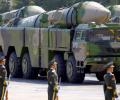
According to the experts, a lot of countries have little or no faith in Chinese companies because of poor after-sales support and equipment that rapidly declines into non-functional machinery.
India has yet again emerged as the world's largest importer of weapons and military equipment, accounting for 15 per cent of global imports, with Russia being its majority supplier, a Stockholm-based think tank said.

The 33 per cent drop in arms imports between 2015 and 2016 affected Russia the most, but India's imports of US arms also fell, by 46 per cent, the report points out.

The report put India's 'stored' nuclear warheads at 172 in January this year while the number for Pakistan was 170.
Trump has a major decision to take in coming days -- specifically, how to rescue Israel from the attritional war that lies ahead, points out Ambassador M K Bhadrakumar.
Pakistan is believed to have 140-150 nuclear warheads this year, 10 more than last year. In contrast, India is said to have 130-140 nuclear warheads, according to the annual nuclear forces data by Stockholm International Peace Research Institute.

'The first and most basic responsibility of any government is to protect its people from external threats and internal harm.' 'Budget 2025-2026 has to focus on meeting this responsibility,' asserts R Jagannathan.
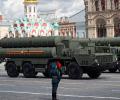
In contrast, India's arms imports from France increased more than tenfold, making it India's second largest arms supplier in 2017-21, it stated.

New Delhi has reached out to Moscow while waiting for a new president in Washington. New Delhi knows well that in international relations, there are no permanent friends or foes, only permanent national interests, points out Dr Rup Narayan Das.

India's defence sector presents an ordering opportunity worth $138 billion between fiscal years 2023-24 (FY24) and FY32, said a latest note by Nomura, which has initiated coverage on two defence-related players - Hindustan Aeronautics (HAL) and Bharat Electronics (BEL) - with a 'buy' rating. The research and broking house sees an upside potential of 28 per cent and 32 per cent, respectively in these two stocks from the current levels.

India spends significantly less on defence than could be expected from a country that faces simultaneous armed threats from two hostile neighbours -- China and Pakistan.

The unmanned aerial vehicle has been developed for surveillance and broadcasting and is ready for commercialisation.

The five biggest spenders in 2018 were the United States, China, Saudi Arabia, India and France, which together accounted for 60 per cent of global military spending, it said.

Officials hint the visit could finally see a formal defence industrial road map being adopted by both nations.

India spent USD 63.9 billion on its military in 2017, an increase of 5.5 per cent compared with 2016 and of 45 per cent since 2008.
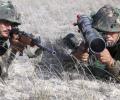
Here is how the two countries stack up militarily, according to a report in AlJazeera.com.
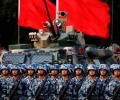
The statements come from a booklet published this month by the state-run People's Publishing House, in which senior officials, including President Xi, outlined the latest five-year plan for the country's development.

The hike in the budget is the lowest increment in recent years apparently due to the heavy disruption caused to its economy by the COVID-19, according to the official media.
That would result in the military under-spending about Rs 80,000 crore over the financial year.
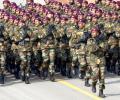
'India is ahead only of Pakistan in the amount spent on each soldier a year.' 'The Indian military is a manpower-heavy throng that is poorly armed, equipped, and trained,' observes Ajai Shukla.

If these reports are true, it means that it possesses something much more powerful than it has tested in the past. North Korea has run nuclear tests in the pasts, but this announcement has sent panic waves internationally.

The GST Council, headed by Jaitley and comprising representatives of all the states, is scheduled to meet in Srinagar on May 18-19 to finalise tax rates on different goods and services after unifying at least 10 indirect taxes into the Goods and Services Tax.

These unmanned aerial vehicles can fly at high speeds, detect intruders, do aerobatic maneuvers like loops, rolls, spins, and hammerheads effortlessly and communicate with each other intelligently.

An expert committee has recommended to Defence Minister Manohar Parrikar that supply of equipment need not be blocked even if bribery charges emerge.

China was the first country to export such sensitive equipment to Pakistan

Anyone within range of China's expanding navy will have to build capabilities faster and/or work more closely with the US, as Australia has just announced, asserts T N Ninan.
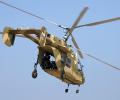
So keen is Moscow that India buy its helicopter -- Kamov-226T -- that President Vladimir Putin personally took up the issue with PM Narendra Modi during their summit meeting last year

At Rediff Labs, we analysed the data on military expenditure by Stockholm International Peace Research Institute.
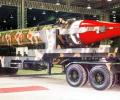
According to the report, Russia tops the table with 6,375 warheads, followed by the United States with 5,800, and the United Kingdom with 215 warheads.

The authoritative Congressional Research Service, which provides data and analysis to the US Congress, finds that India no longer features in the world's three biggest arms importers.

'While China has been hiking its defence spending, India has done precious little in implementing the Manmohan Singh government's decision of raising a 90,000-strong China-centric Mountain Strike Corps,' says Rajeev Sharma.
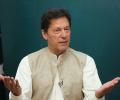
Pakistan's nuclear arsenal is 'simply a deterrent' to protect the country and there will no longer be any need for it once the Kashmir issue is resolved, Prime Minister Imran Khan has said as he asserted that if the Americans have the resolve and the will, the issue can be sorted out.
